Lighting a garden isn’t like lighting a room. Indoors, light bounces off walls and ceilings, filling the space. Outside, there’s nothing to bounce off, so it goes out into the dark and disappears, which is why people install a set of stake lights and then can’t see anything at all.
Disclosure: If you purchase anything from links in this post or any other, I may receive some kind of affiliate commission. However, I only ever mention products I love and would recommend whether I was being compensated or not. You can read my full disclaimer here.
So the good hygge outdoor lighting ideas start from a different question. Instead of asking how to light the garden, ask what specifically you want to see: the table where people sit, the step where someone might trip, the tree you look at from the kitchen window.
For the wider principles behind warm, low, layered light, the full hygge lighting guide covers them.
Light the table first
Here’s the mistake almost everyone makes: The fence gets uplights, the pergola gets rope lights, stake lights go down the path, but the table where dinner actually happens sits in a dim grey pool where nobody can see each other’s faces.
One garden lighting guide describes exactly this, right down to guests reaching for their phone torches within twenty minutes. Faces should be seen clearly without anyone squinting. If you can only afford to light one thing, light the table.
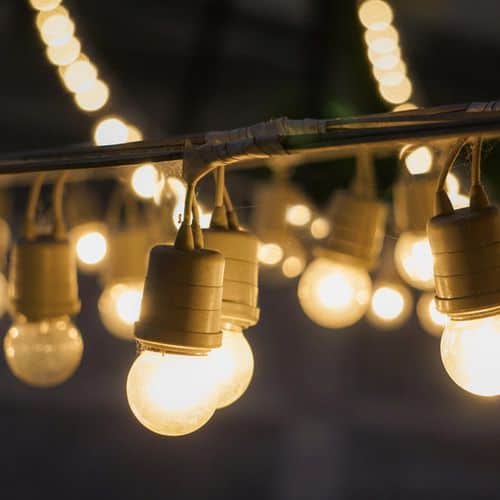
The answer is usually a canopy of string lights overhead, run between the house and a fence post, a tree, or a couple of poles. Use proper outdoor string lights rather than delicate indoor ones, since they will be out in the weather for years.

You might need less light than you think
The main way garden lighting goes wrong is being treated like security lighting. Designers say to light the edges of paths and patios rather than the centres, and to position fittings behind planting so you get depth and shadow rather than a flat wash.
Shadow is part of the design outdoors in a way it isn’t indoors. A garden with three lit elements and plenty of darkness looks considered. A garden with everything lit looks like a car park, which is why the best hygge outdoor lighting ideas usually involve fewer lights than people expect.
There are two placement rules to think about:
- Aim the light at something (a plant, a wall, a surface) rather than at open lawn or sky.
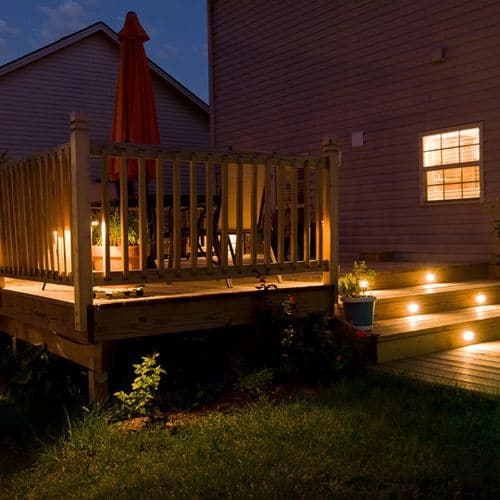
- Light any change in level, since steps and edges are where people could hurt themselves.
Pick one colour temperature and stay with it
Mixing colour temperatures is more obvious outside than inside. A 2700K path light next to a 4000K uplight looks wrong instantly, and landscape lighting specialists say to keep one temperature throughout and layer fixture types instead.
They also make a point that matters a lot in winter: look out of your windows at night and match your outdoor lighting to the rooms facing the garden. You’ll see your garden through glass far more often than you’ll sit in it, so it’s really an extension of your living room lighting for eight months of the year. Warm outside, warm inside, and the window stops looking like a black mirror.
The wildlife bit
This is the part most hygge outdoor lighting ideas miss, and it’s worth knowing before you install anything permanent.
The RHS is direct about it: light pollution is a driver of insect decline. Moths navigate partly by natural light and get disoriented by artificial sources, wasting energy and becoming easier prey. Many bat species avoid lit areas altogether, and security lighting is usually the worst offender in a domestic garden.
Three things help, none of which make your garden worse:
- Warmer light. Amber and warm tones disturb wildlife less than white or blue-heavy light, and you’d choose the same for atmosphere anyway.
- Shield fittings so they point down. Aim light at the ground; it does the job. Light spilling upward does nothing for you, but it does affect wildlife.
- Put everything on a timer. Run garden lights until eleven, then turn them off to give everything else the night.
Getting power out there
Mains outdoor sockets are the reliable option, but they need an electrician. Everything else is a compromise, so it’s worth knowing what you’re choosing.
Solar has improved for decorative and path lighting, though it still can’t match wired systems for consistency or beam control. In winter, solar charges for about four useful hours and then gives you a feeble glow, so treat solar as seasonal.
Battery and rechargeable fittings are the middle ground: proper brightness, no wiring, but you have to remember to charge them. Even better, you could use a rechargeable lantern that lives outside in summer and moves indoors in winter.
If you’ve got a balcony
For balcony lighting, most of the above applies at a smaller scale. String lights along the railing, one rechargeable lantern on the table, and you probably won’t need anything else. Balconies are small enough that two or three light sources are all you need.
Check your building’s rules before making any permanent changes, and be mindful of what shines into the flat next door. Fairy lights can be great in a small outdoor space, and the placement ideas that work indoors apply out here too.
What to buy
- Commercial-grade 2700K festoon lights for the canopy over the table. These have shatterproof bulbs, and they’re linkable if you need more than one run.
- A 2200K weatherproof set of festoon lights if you want the warmer, more candle-like version over a seating area.
- A cordless rechargeable lamp that comes inside for winter and doubles as a table lamp indoors. But don’t leave it outside to get wet.
- A plug timer for whatever’s on mains, so nothing stays on all night.
Start with the table
Run one string of lights above wherever you sit and stop there for this season. It’ll do more than six stake lights, and using the space will tell you what else you need. Most hygge outdoor lighting ideas get more useful once you’ve tried one for a while.
Do you have a garden, a patio, or a balcony? Tell me which, what you have now, and I’ll suggest what to add.
Disclosure: If you purchase anything from links in this post or any other, I may receive some kind of affiliate commission. However, I only ever mention products I love and would recommend whether I was being compensated or not. You can read my full disclaimer here.