Most rooms that feel harsh in the evening aren’t short of light. More often than not, they have plenty, coming from one fixture in the middle of the ceiling, in an office colour. The problem is rarely the amount, but almost always the colour, the height, and how many places it’s coming from.
Disclosure: If you purchase anything from links in this post or any other, I may receive some kind of affiliate commission. However, I only ever mention products I love and would recommend whether I was being compensated or not. You can read my full disclaimer here.
This post covers how to get cozy mood lighting working with the lamps and bulbs you already have, and what’s worth buying afterwards if you still want more. For a full explanation of why this works, the complete guide to hygge lighting covers the theory in more detail.
Start by checking what your bulbs actually are
Bulb colour is measured in kelvin, and the number is printed in small type on the box that nobody reads. Lower numbers are warmer and more orange. Higher numbers are whiter and colder.
For evenings, you want 2700K. That matches the old incandescent bulbs everyone remembers, and it’s the standard warm white across most brands. 2200K is warmer still and feels more like candlelight, which suits a bedside lamp better than a main light.
Anything from 4000K upwards is where things go wrong. That range suppresses melatonin, which is why a bathroom or kitchen can undo an entire evening’s wind-down in about ninety seconds.
Here’s the bit worth knowing: the packaging names are useless. “Soft white” and “warm white” mean different things depending on the manufacturer, so the advice from lighting retailers is to ignore them completely and read the kelvin value instead.
Brightness is a separate measurement altogether. Feit Electric points out that a 2700K bulb and a 5000K bulb can both be 800 lumens, and the two rooms will feel nothing alike. If your lamps feel clinical even on the dim setting, colour or brightness is likely to be the culprit, not wattage.
Go and look at three bulbs in your house right now. If they’re a mix of temperatures in the same room, that alone explains a lot.
Move your lamps lower
Light coming down from a ceiling casts shadows underneath everything, including faces, and exaggerates the gap between a room’s bright spots and its dark spots. Designers say they’re happiest when light arrives at roughly eye level, which in a room where you’re mostly sitting means around table height.
You almost certainly own a lamp that’s currently in the wrong place. A floor lamp standing next to a sofa does more for a room than the same lamp in the corner behind it. A table lamp on a low side table beats the same lamp on a tall shelf.
Try this before buying anything: turn off the ceiling light, turn on whatever lamps you have, and move one to a lower surface. It takes about a minute, and it’s the single biggest free change you can make.
Three small sources beat one big one
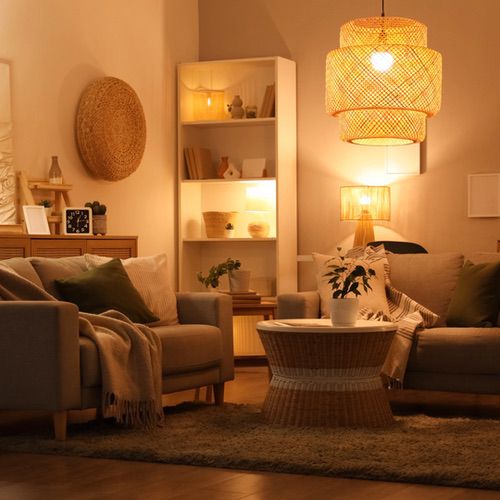
A room lit by one bright thing looks flat. A room lit by three dimmer things has depth. This is because the light falls off between them, giving you shading rather than a uniform wash.
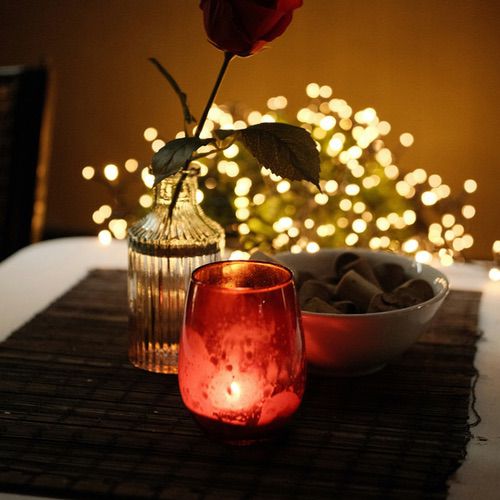
Three is roughly the number to aim for in an average living room, spread across different heights and pushed towards the edges rather than clustered in the middle. A table lamp, something at floor level, and one small source doing a specific job (like lighting a shelf is a reliable combination. Fairy lights count as one of your three, which is why there are so many good ways to use them around a house.
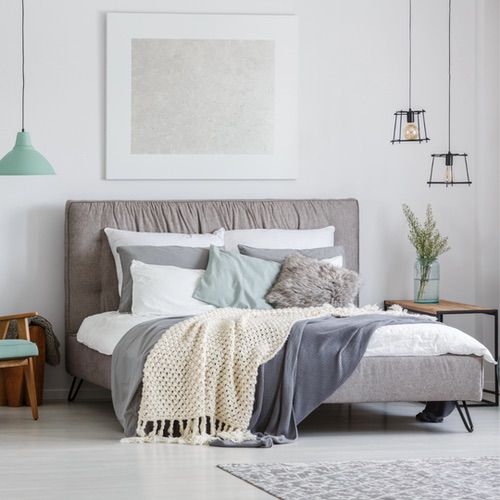
Room by room, the details shift. Cosy mood lighting in a living room is about covering a large space with several small pools of light, while a bedroom needs far less than we think it does.
What to do when the big light has to stay on
There’s a rule going round that you should never use the overhead light, and it’s easy advice to give if you’ve got huge windows and excellent eyesight. Bed Threads made the sensible version of this argument: what people actually dislike is a single harsh cold bulb on a plain on/off switch, rather than overhead light as a concept.
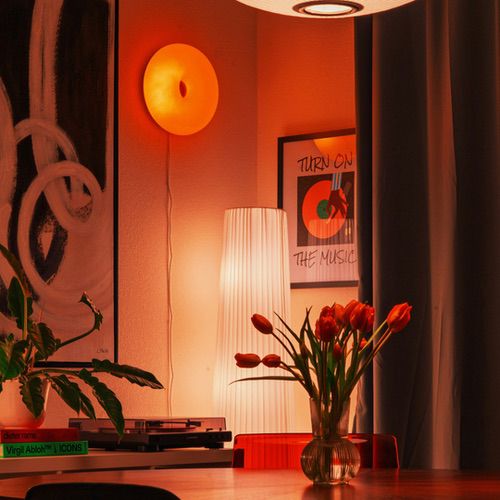
If you’re chopping onions or helping with homework, use the big light. The fix is to make it warmer and dimmer. Put a 2700K bulb in it, add a shade that diffuses rather than directs, and give it a dimmer so it has more than two settings. The kitchen is where this matters most, since it’s the room where good task lighting and cosy mood lighting have to coexist.
The three things worth buying
If you’ve done all that and still want more, spend in this sequence.
- Warm bulbs. A multipack of 2700K dimmable A19 bulbs so you can standardise a whole room at once. Cheapest change with the biggest effect.
- A dimmer for a lamp you already own. A plug-in slide dimmer sits between the lamp and the socket and needs no wiring, which makes it a good option for renters.
- A plug timer. Set your lamps to come on at four o’clock in winter so you walk into a lit room instead of flipping the big light on out of habit.
Nothing on that list is necessarily expensive, but they can make a difference. Cosy mood lighting is mostly a matter of colour and placement, and both are free.
Try one thing tonight
Pick the room you spend the most time in, turn off the ceiling light, and see what you’re left with. If it feels too dark, you might need another light source; if the colour is wrong, you might need to change the bulbs. That one experiment tells you a lot more than you think it will
What room in your house never quite feels right in the evening? Tell me in the comments, and I’ll suggest where to start.
Disclosure: If you purchase anything from links in this post or any other, I may receive some kind of affiliate commission. However, I only ever mention products I love and would recommend whether I was being compensated or not. You can read my full disclaimer here.